

6th India Public Policy Network Conference | June 8 to 11, 2026
NLSIU Campus
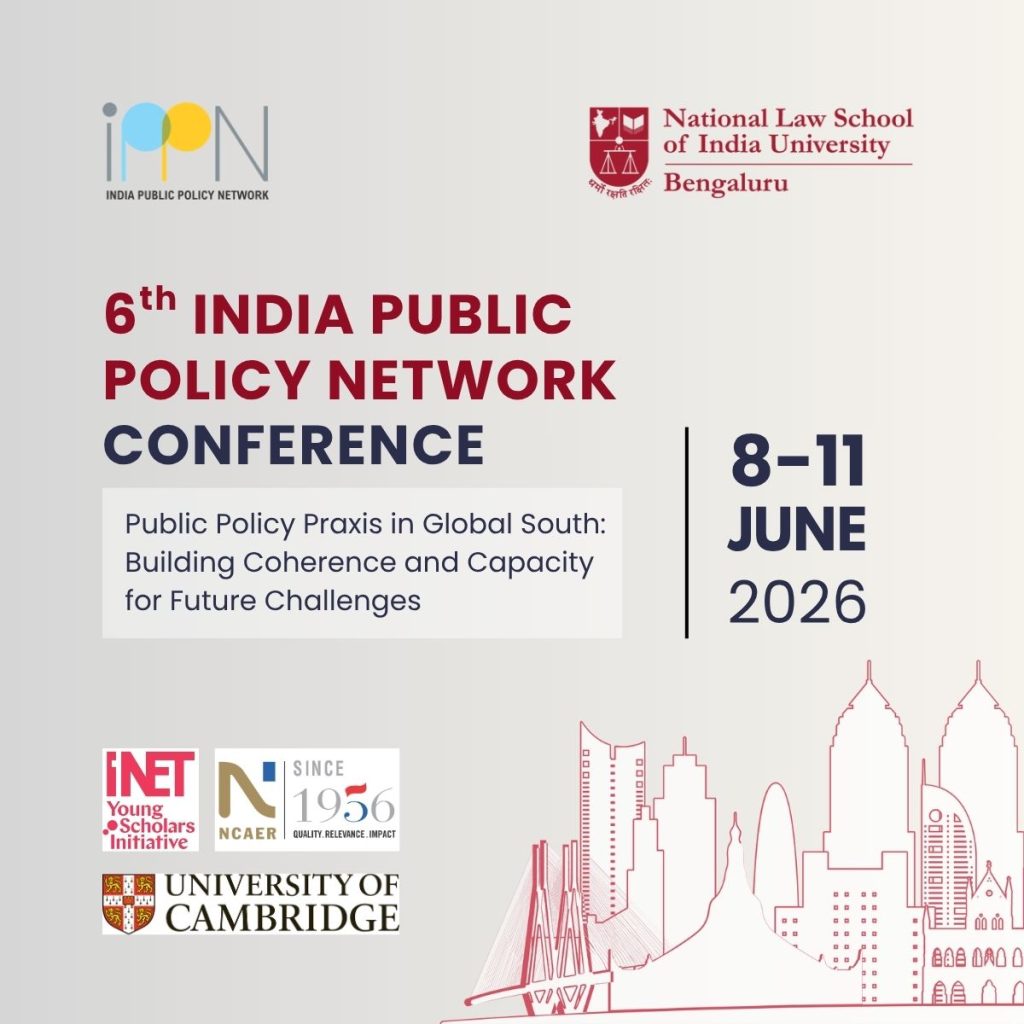
The National Law School of India University (NLSIU), Bengaluru is hosting the 6th India Public Policy Network Conference (IPPN) from June 8 to 11, 2026. The theme for this edition is ‘Public Policy Praxis in the Global South: Building Coherence and Capacity for Future Challenges.’
The conference is hosted at NLSIU in collaboration with India Public Policy Network, University of Cambridge (Department of Land Economy), INET (Young Scholars initiative) and National Council of Applied Economic Research (NCAER).
Public Policy Praxis in Global South
Public policy praxis—the knowledge derived from practice and reflection—is transforming governance across developing economies. In India, this transformation is visible through the exponential growth of policy education programs, research institutions, and a vast industry of policy practice that spans government, consulting, and civil society. Yet, this expansion unfolds amidst technological, administrative, ecological, and political shifts that challenge existing legal and policy frameworks.
Developing economies are now key laboratories for governance innovation. From AI-enabled service delivery to local-level participatory experiments, these contexts highlight how governance capacity, institutional coherence, and policy equity must evolve together. The conference invites reflection on how public policy praxis can help bridge theory and action, regulation and innovation, and local and global approaches to policymaking.
We aim to foster dialogue between academia, practitioners, and policymakers to explore how developing economies can build coherence and capacity to meet future challenges in governance, technology, and sustainability.
Conference Tracks
The conference will be structured around three central tracks:
Panels within this track will examine how law and public policy are taught in developing economies, with a focus on curriculum design, pedagogy, and the integration of emerging issues such as technology, sustainability, and inequality. Discussions will include the challenges of interdisciplinary teaching, the use of case-based and experiential learning, and how to prepare students for careers at the intersection of law, governance, and policy. The teaching track will also explore how new technologies—AI, online learning, and digital classrooms—are reshaping the delivery of legal and policy education.
A glimpse of thematics that will be explored:
What are the kinds of learning outcomes expected beyond disciplinary foundations?
How have experiential learning components been designed that are not necessarily focussed on empirical reporting and for academic research?
How do programmes balance generalist teaching and sectoral depth?
What are the pedagogical approaches being used to incorporate heterodox approaches that can overcome disciplinary boundaries?
What kinds of innovations have been tried in assessment, concept building, application ability to meet learning requirements?
How is public policy praxis in India being taught that makes it distinct from standard western approaches to teaching Public Policy?
This track will focus on academic scholarship addressing the governance challenges of developing economies. Papers and panels will explore methodological innovations in studying law–policy intersections, comparative governance in the Global South, and the role of interdisciplinary frameworks. Key themes include technological governance, digital inequality, climate change, urban transformation, and human rights in digital spaces. The research track will highlight how developing economies are not only case studies but also producers of theoretical insights that can shape global debates.
Some illustrative themes include the following:
-What are the challenges to policymaking for sustainability in India and how can they be addressed?
-How do law and policy interact in the face of uncertainty?
-What are the emerging policy issues within sectors that require further research? What lessons can be drawn from comparative studies of governance in the Global South?
-What has been the impact of networks and actors on governance?
-How can developing economies balance innovation and regulation in policymaking?
-What are some new concepts and methodologies that are relevant to public policy research in India?
This track will bring together policymakers, practitioners, lawyers, and civil society actors to discuss how law and policy reforms are implemented in practice. It will highlight real-world innovations such as e-governance platforms, fintech regulation, community-driven governance, smart city initiatives, and dispute resolution mechanisms. Panels will emphasize lessons learned from the field, including both successes and failures, and explore how legal frameworks can be made more adaptive, participatory, and responsive to local contexts.
-What interventions have worked and what have not and why?
-How do legal practitioners address public policy challenges?
-How do policy practitioners understand and address the legal dimensions of policy?
-What areas of research do practitioners expect from the academic community?
-How can we explore and consolidate collaborative practices between academia, law, and the policy community?
Conference Schedule
Pre-Conference Day | 8th June 2026 |
02: 30 PM to 5:30 PM:
Masterclasses on Methodologies for early career researchers and participants of the conference.
-Textual data and Natural Language Processing in policy research : Dr. Nihit Goyal (Assistant Professor, Delft University of Technology (TU Delft), Netherlands.
-Using fuzzy set qualitative evidence for comparative methodology– QCA : Dr. Srikrishna Ayyangar (Associate Professor, National Law School of India University, Bengaluru, India)
-Forms of reasoning in public policy : Dr. Sony Pellissery (Professor and Director at the Centre for the Study of Social Inclusion, National Law School of India University, Bengaluru, India)
-How to design a survey questionnaire for social science research? : Dr. Siddharth Swaminathan (Associate Professor, National Law School of India University, Bengaluru, India)
-Fieldwork in India : Prerna Mukharya (Outline India)
Day 1 | 9th June 2026
8:30 am: Opening remarks
Sri Narayan Rao Melgiri Memorial National Law Library
09:15 AM to 10:30 AM: Panel discussions (Session 1)
10:45 AM to 12 noon: Panel discussions (Session 2)
12:15 PM to 1:30 PM: Panel discussions (Session 3)
2:30 PM to 4:30 PM: Plenary session
4:45 PM to 6:00 PM: Panel discussions (Session 4)
Day 2 | 10th June 2026
09:00 AM to 10:15 AM: Panel discussions (Session 1)
11:00 AM to 12:15 PM: Plenary session
12:30 PM to 1:45 PM: Panel discussions (Session 2)
2:30 PM to 3:45 PM: Panel discussions (Session 3)
4:00 PM to 5:15 PM: Panel discussions (Session 4)
Day 3 | 11th June 2026
9:00 AM to 10:15 AM: Panel discussions (Session 1)
10:30 AM to 11:45 AM: Panel discussions (Session 2)
12 noon onwards: Closing sessions
List of panels
Click here to see full conference schedule, masterclass sessions, panel details and other information.
Plenary Session I
Public Policy Praxis in the Global South: Building Coherence and Capacity
9 June 2026 | 2:30 PM – 4:30 PM | Shri Narayan Rao Melgiri Memorial National Law Library
Moderated by Prof. Sudhir Krishnaswamy (Vice Chancellor, NLSIU), the session brings together distinguished leaders from academia, philanthropy, government, international development, and industry:
-
Dr. Shailaja Fennell, University of Cambridge
-
Ms. Shalini Kapoor, EkStep Foundation
-
Mr. L. K. Atheeq, Chairman, Bengaluru Business Corridor
-
Dr. Shishir Sankhe, Senior Partner Emeritus, McKinsey & Company
-
Ms. Neha Gupta, Senior Public Sector Specialist, World Bank
The discussion will focus on strengthening policy capacity, institutional coherence, and collaborative approaches to policymaking in the Global South.
Plenary Session II
Public Policy Education and Pedagogy in the Global South
10 June 2026 | 11:00 AM – 12:15 PM | Shri Narayan Rao Melgiri Memorial National Law Library
Moderated by Dr. Sneha Thapliyal (NLSIU), this session will explore the future of public policy education, curriculum design, and capacity building in rapidly changing policy environments. Speakers include:
-
Dr. Satyajit Singh, University of California, Santa Barbara
-
Dr. Aparna Chandra, National Law School of India University
-
Dr. Ishani Mukherjee, Singapore Management University
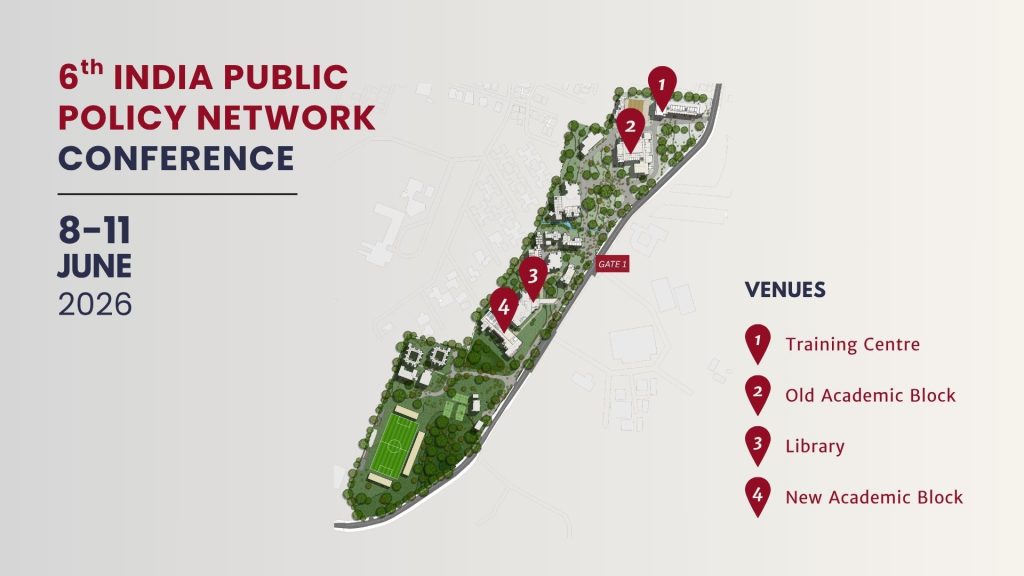
Conference Venues
Contact Us
For any enquires, reach out to us at .
Related Links
Call for Panels | 6th India Public Policy Network Conference | IPPN – NLSIU 2026 | June 8-11, 2026
Call for Papers | 6th India Public Policy Network Conference | June 8-11, 2026